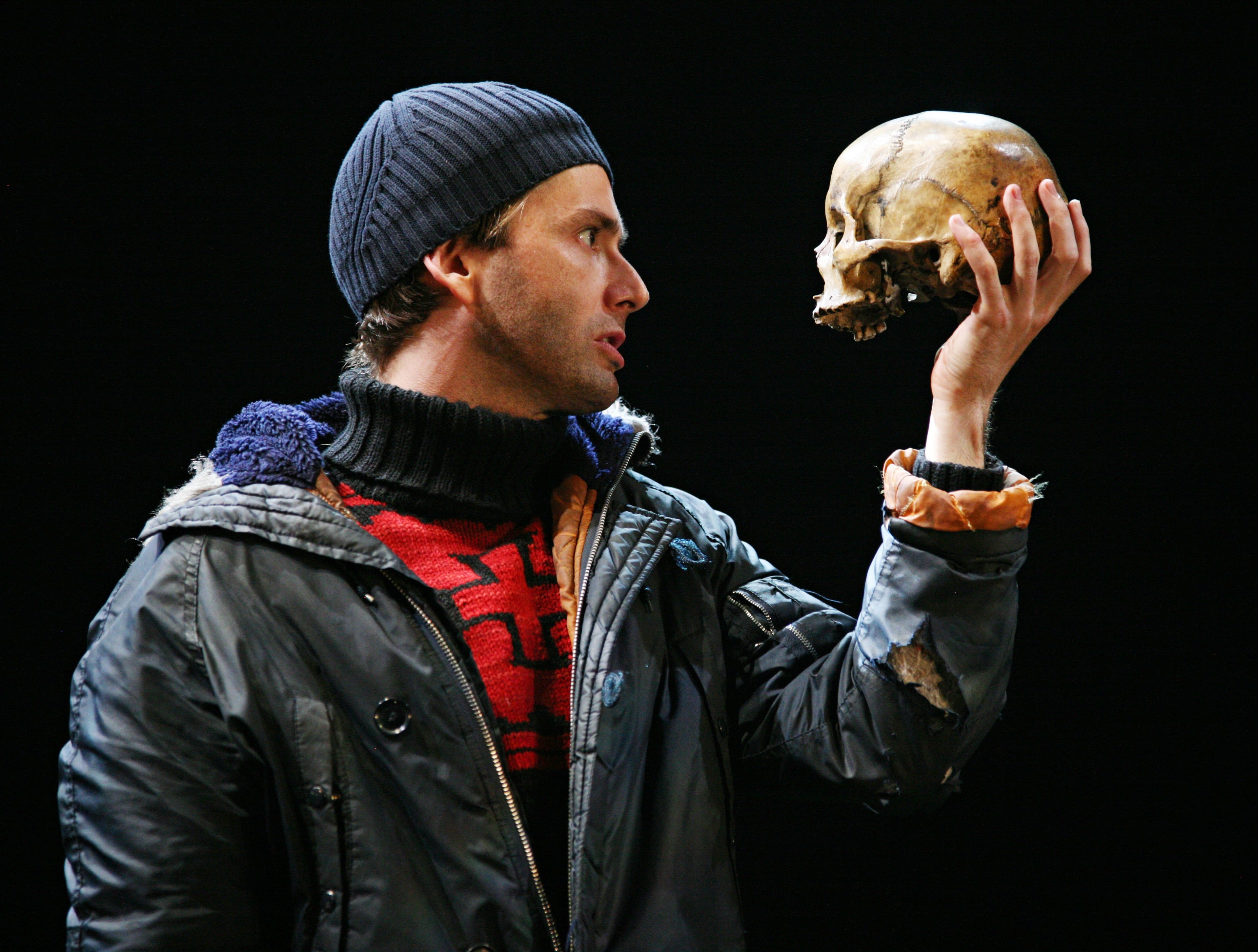
Thursday, January 19, 2017

Hamlet 2.1

Miming Madness?
Pantomime what isn't seen in 2.1.84-134.

Groups of three...

One student will read the lines while the other students mime the prescribed actions, including adjustments to clothing.   

What is Hamlet up to in this scene?
Why is he treating Ophelia this way?
Does he love Ophelia?
If so, what possible reasons could he have for acting this way towards her?
What about Ophelia - does she love Hamlet? What is her reaction to his behavior? Try to pinpoint her emotions.

Remember, Hamlet wears the guise of madness so that no one suspects him of trying to plot his revenge to avenge his father's murder.  

HW: This weekend, read 2.2.1-403 (pp  and do reading log # 5)

Reading log sharing

Read Aloud 2.1.1-83

Circle words and phrases that reveal Polonius's values.

What do you think they reveal about Polonius's values?

What are several character traits we can infer from his words and behaviour? 

It takes one to know one?  What do you think Polonius might have been like as a young man?

Pantomime what isn't seen in 2.1.84-134.

Groups of three...

One student will read the lines while the other students mime the prescribed actions, including adjustments to clothing.   

What is Hamlet up to in this scene?
Why is he treating Ophelia this way?
Does he love Ophelia?


Tuesday, January 17, 2017

HW: Read act 2, scene 1 (pp 73-81):

Do Reading Log #4


Something to think about:  Why would a father spy on his son? What might it suggest about the way the father behaved when he was a young man?

Watch Hamlet Act 1

Friday, January 13, 2017

With a partner, read aloud Hamlet's Soliloquy (alternating every two lines) and then answer # 6;


Discuss questions 1, 2, 3 and 5 in groups of four.  One person leads the discussion of each respective question, seeking input from each member of the group.

Watch Hamlet Act 1, scenes 1-2

Homework: Read Act 1, Scenes 3 & 4 and do reading log # 3

Wednesday, January 11, 2017

Hamlet Day 3 Act 1.2 logs # 2 & 3

January 12, 2017

Reading Log # 2 (a departure from the normal format):  In reading scenes 1 and 2 leading up to Hamlet's tortured soliloquy in lines 132-165 of act 2, what situations have you come across which might contribute to Hamlet's stress and despair? 

Write a paragraph which explains some reasons that Hamlet is feeling so horrible. Embed two short to three short quotes in your response (properly cited with the the act. scene. line in parentheses at the end of the sentence containing the quote).  

Exchange paragraphs with someone near you.

A close reading of Claudius's opening speech in Scene 2


Hamlet, Act 1, Scene 2: “Weighing Delight and Dole”
Question or focus prompts
Your response (in your own words) and any supporting textual evidence and/or properly cited lines (act, scene, and line #’s, e.g., 1.2.40-47)
1) A second look at King Claudius’s opening speech up until he begins addressing Hamlet directly 1.2.1-133

The use of the royal “we”; usually only used in addressing political matters (“I” is used in personal matters). 

When does Claudius use “we” (or "our" or "us)?

When does he use “I”?

What pronoun “we” or “I” does he use in addressing Hamlet directly? (1.2.90-121)

Why do you think he uses this particular pronoun rather than the other one?


2) Antithesis (1.2.9-13): Look for antithesis, the balancing of two contrasting ideas, words, phrases, or sentences in parallel grammatical form: “with mirth in funeral and dirge in marriage”, etc.  What feelings do these juxtapositions evoke for you? What feelings do you think Claudius wished to evoke by using them? Do they match your feelings?


3) Choice of words:  Why does Claudius remember old King Hamlet with “wisest sorrow” (1.2.6) rather than “deep sorrow”?  Why does he say it “befitted” (1.2.1) them to bear their “hearts in grief”?


4) Order of ideas Claudius presents: Although Hamlet’s mourning is of major concern to Claudius, why does he justify his marriage to Gertrude, deal with Norway’s impending invasion, and respond to Laertes’ petition before he addresses Hamlet?


5) Looking for underlying thoughts of Hamlet and Claudius

Examine the exchange between Claudius and Hamlet in 1.2.66-96 (“But now, my cousin Hamlet and my son” to “To do obsequious sorrow” with an emphasis on understanding the subtext of each character in this scene.

When Claudius says, “But now, my cousin Hamlet and my son,” what does he really want? What is he thinking? Why might he choose a public place to greet Hamlet?


When Hamlet says, “’Seems,’ madam? Nay, it is. I know not ‘seems’” what does he really mean? What is he thinking about his mother? Why does Hamlet use puns (like the pun on “kind” which can mean “affectionate” or “natural and lawful” in line 67, and the pun on “common” which can mean both “universal occurrence” and “vulgar” in line 76) and riddles (like his reply in line 69, “Not so my lord.  I am too much in the sun,” to Claudius’s question “How is it that the clouds still hang on you?” when he speaks to Gertrude and Claudius?


6) Re-read Hamlet’s soliloquy “O, that this too, too sullied flesh” (1.2.133-164) a couple of times and try to paraphrase it with your partner.

What signals in the language give clues to Hamlet’s innermost thoughts – for example, choice of words, construction of phrases, sequence of thoughts?

Does he hide behind puns as he does with Claudius? What does the antithesis reveal?


HW: Complete boxes 1, 2, 3, 5 & 6 and finish reading scene Act 1, scene 2 (lines 165-280) 


Quick review of reading journal guidelines

15 minutes to compose journals

Exchange journals with someone who has the same assigned number; read and comment on each of their three entries (a simple phrase which reinforces, adds to, or questions something they wrote)

HW: Please read Act 1, Scene 2 lines 1-165 (middle of page 31). This is a very important scene in the play, establishing some of the most relevant external and internal conflicts. Tomorrow you will work with a partner or two to read aloud and answer questions about the scene. NO READING JOURNAL TONIGHT.